
For years, I've observed the best-in-class operators follow the same playbook: to do more, build a bigger team. Need to process more invoices? Hire more analysts. Need faster customer response times? Add another shift. The scaling model was always headcount.
But most non-technical teams have largely ignored automation entirely. Engineering and DevOps embraced CI/CD pipelines and infrastructure-as-code years ago. Operations, finance, HR, and customer success? They kept scaling the old-fashioned way: more people, more spreadsheets, more meetings to coordinate the people managing the spreadsheets.
AI agents change the equation. For the first time, automation doesn't require a team of developers to build and maintain. It doesn't require fragile scripts that break the moment a vendor updates their portal. Agents can interpret ambiguity, handle unstructured data, and adapt on the fly. The barrier that kept non-technical teams away from automation is finally gone. Gartner predicts that 40% of enterprise applications will embed task-specific AI agents by the end of 2026, up from less than 5% just a year prior.
The Verdict: Invest in the Brain
If you're an Operations Manager or a Developer, here is the short version of what you need to know about the automation landscape today.
| Architecture | Role | Best For | 2026 Status |
|---|---|---|---|
| Traditional RPA | The "Hands" | Fixed, high-volume repetitive tasks | Legacy / Execution Layer |
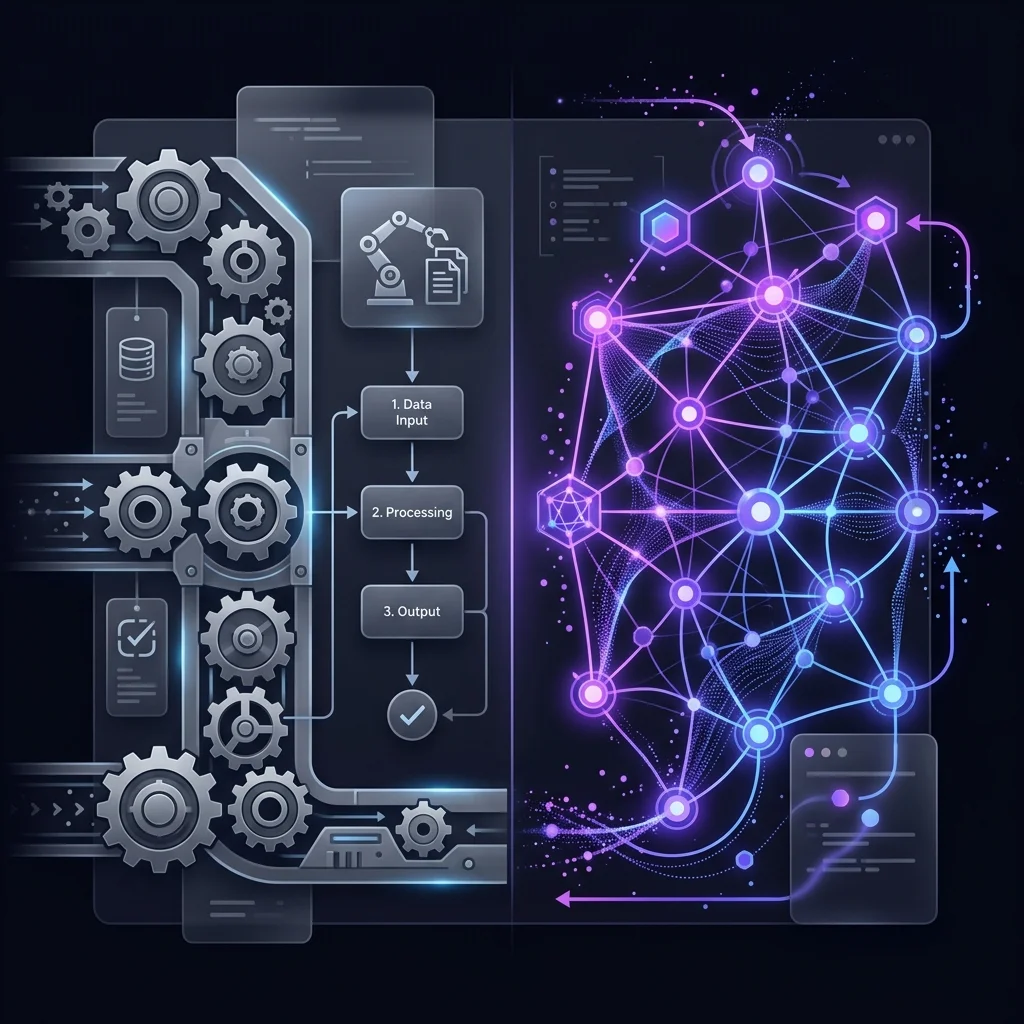
| AI Agents | The "Brain" | Ambiguity, unstructured data, dynamic decisions | The Orchestration Layer |
| Hybrid Systems | The "Full Body" | End-to-end resilient processes | The Gold Standard |
The single most important takeaway is this: stop trying to script every possible exception. Instead, build a system where an AI agent makes the decisions, and the RPA handles the execution.
The Problem with Brittle Bots
Traditional "bots" have a fatal flaw: they break the moment a UI changes or a data format shifts. The cost of keeping them alive adds up fast.
According to HfS Research, licensing accounts for only 25–30% of total RPA costs. The remaining 70–75% is consumed by implementation, consulting, and ongoing maintenance. For every $1 spent on licensing, enterprises spend roughly $3.41–$4.00 on consulting and maintenance just to keep bots functional.
Ernst & Young reports that 30–50% of RPA projects fail to reach their objectives or scale beyond the pilot stage. The technical debt of maintaining hundreds of fragile scripts compounds as more bots are deployed, and each one becomes a potential failure point the next time a source application gets updated.
Organizations are finally moving from maintaining these fragile tools to orchestrating resilient multi-agent systems. Rather than saying "click here, then copy this," we are now giving agents a goal: "resolve this customer issue." The agent figures out the best path.
Important Consideration
The Hybrid Reality: AI hasn't completely killed RPA. Traditional automation still offers unmatched stability and low cost-per-execution for deterministic tasks. The winning strategy is using AI as the reasoning layer on top of those existing scripts.
Real Results: Who's Already Making the Switch
This shift isn't theoretical. Enterprises are already seeing real results from deploying AI agents at scale.
Salesforce: 1.5 Million Cases, 85% Resolved Autonomously
Salesforce deployed its Agentforce platform on its own help site as "Customer Zero." After one year of operation:
- Over 1.5 million support requests handled by AI agents.
- 85% resolved without human intervention, maintaining high customer satisfaction.
- An SDR agent generated $1.7 million in new pipeline from previously dormant leads.
- Internal Slack agents saved employees approximately 500,000 hours.
One key lesson: Salesforce initially set the human hand-off rate at just 1%, which hurt customer satisfaction. They adjusted it to 4%, finding the right balance between efficiency and empathy.
ServiceNow: 52% Faster Case Resolution
ServiceNow's agentic AI deployment reduced the time required to handle complex service cases by 52%. Instead of scripted chatbots following a decision tree, their agents access enterprise data, coordinate workflows, and execute actions across systems, adapting to context in real time.
These aren't experimental pilots. These are production-scale deployments processing millions of interactions.
Building the Modern Stack
When setting up these workflows, I've seen teams struggle with older platforms that weren't designed for agentic behavior. The tooling has caught up.
This is how the current orchestration landscape breaks down:
| Tool | Type | Best For | AI Agent Support | Pricing |
|---|---|---|---|---|
| n8n | Low-code | Technical teams, self-hosting | Native AI Agent + LLM nodes | Free (self-hosted) / Cloud plans |
| Make | Visual automation | Power users, complex branching | Moderate (deterministic) | Per-operation |
| Zapier | No-code | Non-technical, fast setup | Basic ("Zapier Agents") | Per-task (expensive at scale) |
| LangGraph | Dev framework | Engineers, custom agent logic | Full control (code-based) | Per-token / compute |
I like n8n because it sits right in the middle. You can wire up standard API calls alongside LLM nodes that interpret unstructured emails or PDFs. If you self-host, you eliminate per-execution fees entirely.
Most mature teams in 2026 use a hybrid approach: n8n or Make for the "plumbing" (connecting apps, triggering workflows, data ingestion) and LangGraph for the "brain" (complex, reasoning-based agent logic called via API).
Pro Tip: If you're a developer, start treating your existing APIs as "tools" that your AI agents can call. This instantly turns your static infrastructure into an agentic playground.
The Personal Angle: Real ROI
The best part of outcome-oriented design is that I don't have to worry about a workflow crashing because a vendor changed their invoice layout. The AI agent interprets the new layout on the fly.
This resilience is why investing in the "brain" pays off. The initial setup requires more thought (prompt engineering, guardrails, governance), but the long-term maintenance burden drops significantly. Instead of scrambling to fix scripts every time a portal gets redesigned, the agent adapts.
That said, it's not a free lunch. You trade script-maintenance for new costs: token spend, prompt tuning, and building proper guardrails. Gartner warns that over 40% of agentic AI projects could fail by 2027 due to poor governance. The teams that win are the ones investing in orchestration frameworks and human-in-the-loop oversight from day one.
Getting Started: A 3-Step Playbook
If you're ready to make the shift, this is the path I recommend:
Step 1: Audit Your Existing Automations
Identify your most brittle bots, the ones that break frequently or require constant maintenance. These are your best candidates for an AI agent layer. Look for processes that involve unstructured data (emails, PDFs, varied invoice formats) or frequent exceptions.
Step 2: Start with One Hybrid Workflow
Don't rip and replace. Pick a single high-maintenance process and build a hybrid: keep the RPA execution for the deterministic steps, but add an AI agent to handle the interpretation and decision-making. Tools like n8n make this practical with their native AI Agent node.
Step 3: Invest in Guardrails Early
Define escalation rules, set up role-based permissions, and build audit trails from the start. The biggest risk with autonomous agents isn't capability. It's accountability. Treat governance as a feature, not an afterthought.
Ready to upgrade your automation? Stop writing fragile scripts and start orchestrating smart agents.