Bottom Line Up Front: I used to recommend Google Antigravity, but after months of running both side by side, I can't put it ahead of Claude anymore. I've moved my daily AI coding work to Claude Code, mostly Opus 4.8, and I'm not going back.
I liked Antigravity. I recommended it to friends. The Gemini 3.5 and Gemini 3.6 Flash models behind it are fast, and speed matters when you're deep in a build. But after months in both tools, the thing that used to impress me is the thing that pushed me away.
Forget spec sheets. What matters is how each tool behaves when you hand it real work.
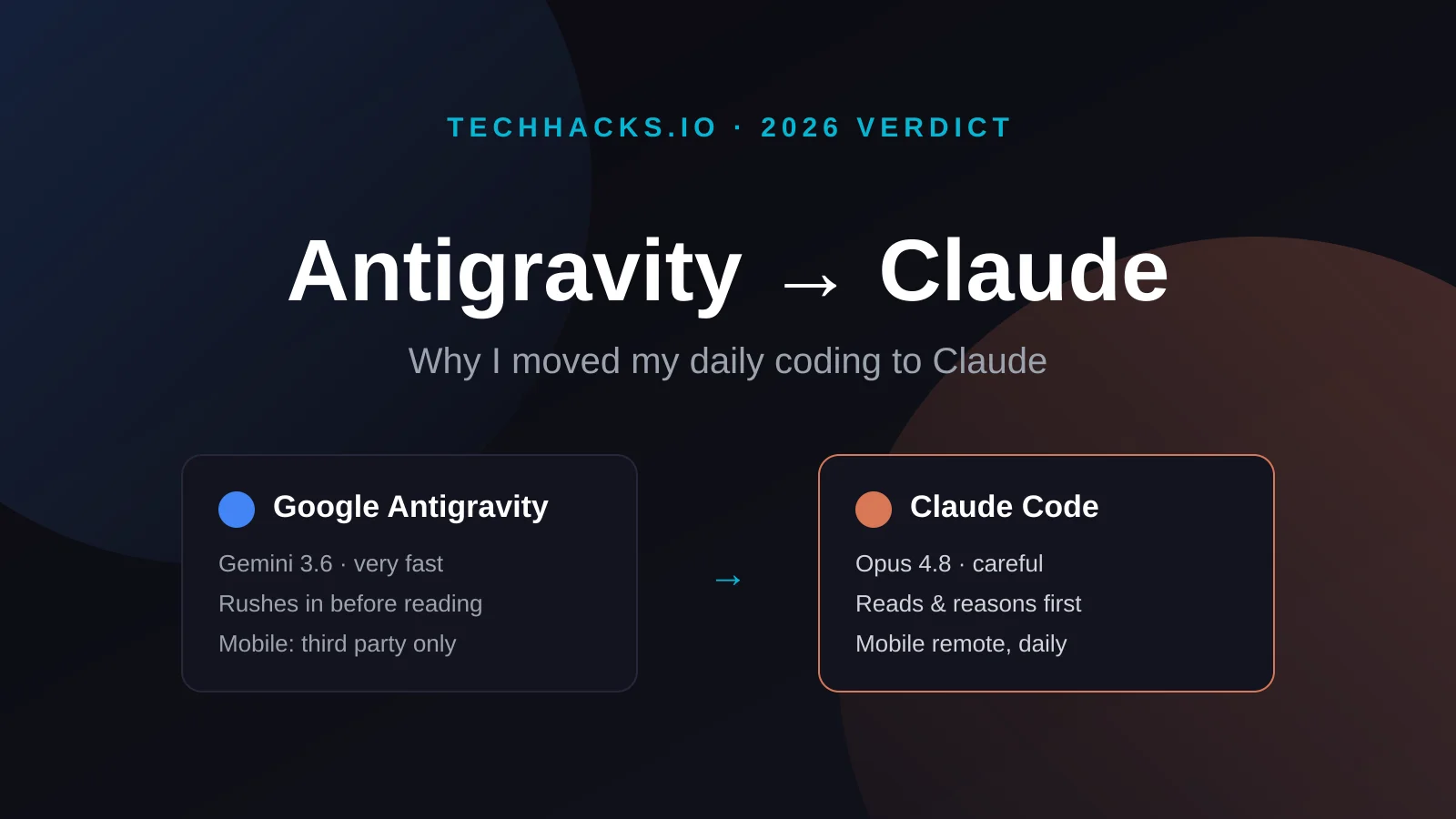
My honest 2026 verdict after months on both Antigravity and Claude Code.
How They Compare
| What I Care About | Google Antigravity (Gemini 3.6) | Claude Code (Opus 4.8) |
|---|---|---|
| Raw Speed | Excellent (very fast) | Slower, more deliberate |
| Codebase Awareness | Rushes in before reading enough | Reads and reasons first |
| Mobile Remote Control | Third party only, not polished | First party, works daily |
| Harness Polish | Rocky (2.0 launch wiped configs) | Mature and stable |
| My Daily Driver? | Not anymore | Yes |
Antigravity is still a capable tool and Gemini is still a serious model family. This isn't a takedown, just where I landed after using both for real.
It Writes Before It Reads
Gemini 3.5 and 3.6 are fast. Google shipped 3.5 Flash at I/O in May, and it runs circles around older models on coding benchmarks. The 3.6 Flash update in July made it the workhorse and trimmed token usage on top of that. On paper it's a monster.
The problem is what it does with that speed. Earlier this year, on a side project, I thought I'd found the ideal arrangement. Claude wrote the spec, Antigravity coded it out. Judgment from one, throughput from the other.
It held up for a while. Then I started handing the finished work back to Claude to review, and it kept surfacing the same class of problem. Edge cases the spec had assumed would keep working. Existing behaviour that had quietly stopped behaving. Nothing that announced itself, and nothing I'd have caught skimming the diff.
Each fix took minutes. That's exactly why it took me so long to notice. No single repair was big enough to make me question the setup, and the speed looked real right up until I started counting what the reviewing cost me.
So I stopped splitting the work and gave the whole job to Claude.
Important Consideration
I'm not the only one seeing this. In a review after heavy use, Jose Canciani hit the same wall. Prompts like "what do you think of this?" or "is this a good idea?" get ignored and the agent carries on with the plan regardless. He ended up having to instruct it explicitly not to modify anything.
Claude is slower. There's no getting around it, and early on that frustrated me. It reads more files and traces dependencies before it edits. Over months I came to value that patience more than raw speed.
A fast wrong answer costs me more than a slow right one. I don't have a dramatic story about Claude catching something enormous, and honestly that's the point. The trust built up out of not having to go back and check.
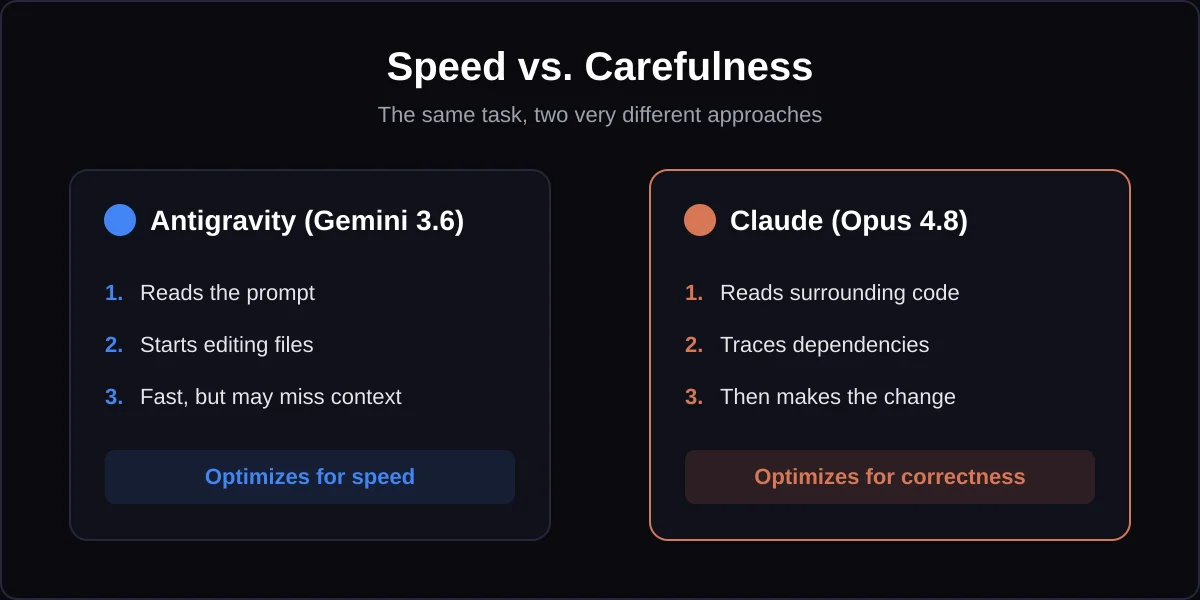
The tradeoff in one picture: Antigravity optimizes for speed, Claude optimizes for getting it right.
Speed feels great in a demo. Care feels great in production. If you have to maintain the codebase afterwards, the second one wins.
This lines up with what I've read elsewhere. CodeRabbit ran Opus 4.8 across 100 open source pull requests and found its biggest gains in cross file reasoning, clearest on the most complex ones. They also found it flagged fewer critical issues than their own baseline, so it isn't a clean sweep, but the part I care about is the part it's strongest at. If you want the deeper value breakdown, I wrote about it in my Claude Code vs Gemini CLI comparison.
The Mobile Remote Control I Use Every Day
This one is bigger for me than most people expect. My favorite thing about Claude is remote control from the mobile app, and I mean that literally. I use it nearly every day.
Anthropic shipped Claude Code Remote Control in late February. It bridges the session running on my desktop to the Claude app on my phone. The work still runs on my machine and my code stays local, but I can steer it from anywhere.
I can start a task, leave my desk, and keep nudging it along from my phone while I do something else.
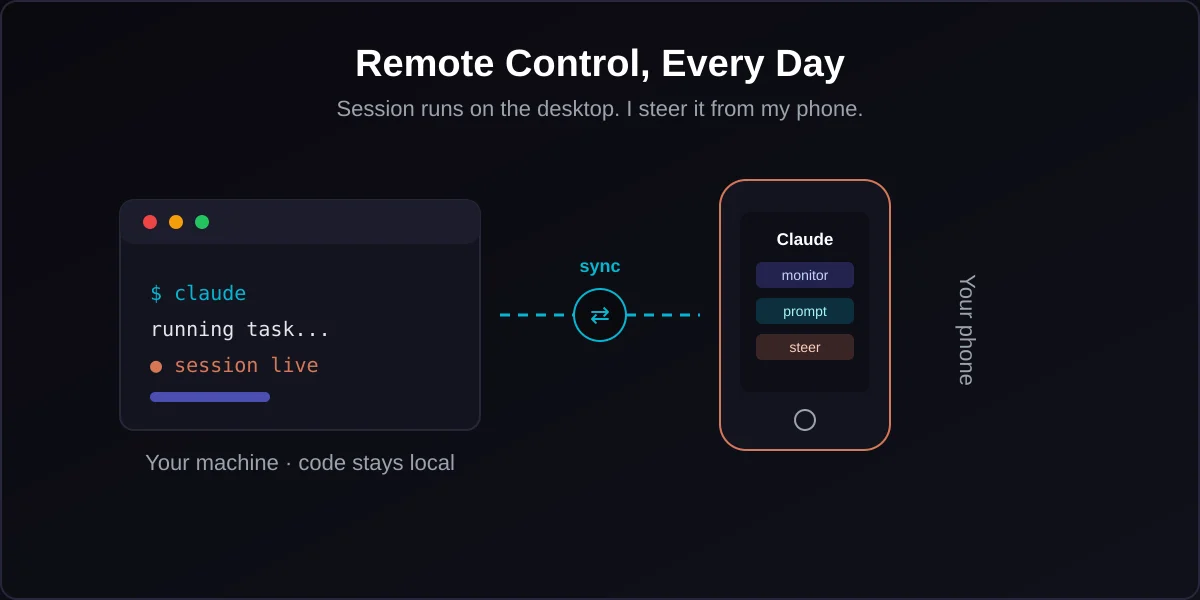
The workflow I lean on daily: start on desktop, steer from mobile.
Antigravity seems to be moving in this direction, especially with the Manager view and background agents in 2.0. But there's no polished first party mobile app yet.
What exists today for Antigravity on mobile is community built. Projects like Antimatter (open sourced in June) and AG Remote (a native iOS app) are filling the gap. They're impressive, but they aren't the same as a first party experience that just works.
Important Consideration
There's a difference between "a mobile option technically exists" and "I reach for it every day without thinking about it." Claude is the second one for me. Antigravity isn't there yet.
The Harness Feels More Mature
I don't have a strong opinion on the coding harnesses themselves. Both are good, and the models do most of the heavy lifting either way.
Claude Code still feels more polished to me. It's stable, the workflow is coherent, and it rarely surprises me in a bad way.
Antigravity's 2.0 launch, by contrast, was rough. Google pushed it out automatically on May 19, the same day it was announced at I/O, and developers opened their machines to find terminals, file explorers and editing tools gone. Active projects were left unusable, with no opt in and no rollback path.
When you depend on a tool for daily work, "boring and stable" is a feature. I'd rather have a mature harness than a flashy one that breaks my setup on an auto update.
This is the smallest of my three reasons. If the models behaved the same I'd happily use either harness. They don't, and that's what tips it.
Where That Leaves the Recommendation
Straightforward. I can't recommend Gemini 3.6 or Google Antigravity over Claude anymore.
Part of why I recommended it in the first place was the bundle. Google One AI Pro hands you developer credits alongside the storage and everything else, and on paper that's a lot of value for one subscription. But a bundle is only worth what you actually use it for, and coding was the thing I wanted it for. If the coding isn't as good, the storage doesn't make up the difference.
If you're choosing a daily coding agent in 2026, I'd point you at Claude, either Sonnet or Opus. I run Opus 4.8 almost every day over Sonnet, because the extra care on hard, multi file work is worth the wait.
None of this means Gemini is bad. It's fast and capable, and if you're prototyping something you won't have to maintain, that speed is the right trade. I still open Antigravity now and then, just less every month. If you want the wider picture, see my Gemini vs Claude vs ChatGPT value comparison and the breakdown of the three types of AI agent workflows.
But for how I work, care beats speed, and the mobile remote control has become a habit I won't give up.
See the Full Value Breakdown
Trying to decide where your money goes? I break down what you get for $20 a month across both ecosystems.
The Short Version
Important Consideration
My 2026 Verdict
- Speed isn't the win I thought it was. I ran Claude for specs and Antigravity for code until the reviewing overhead ate the time the speed saved.
- Claude is slower and more careful, and that carefulness compounds into trust over time.
- Mobile remote control on the Claude app is a daily habit for me. Antigravity's mobile story is still third party and unpolished.
- The harness feels more mature, though that's my smallest reason.
- The Google One bundle stopped justifying it. Great value on paper, but not if the one thing you bought it for is the weaker option.
- My pick: Claude, on Opus 4.8 most days. I can't recommend Antigravity over it anymore.